


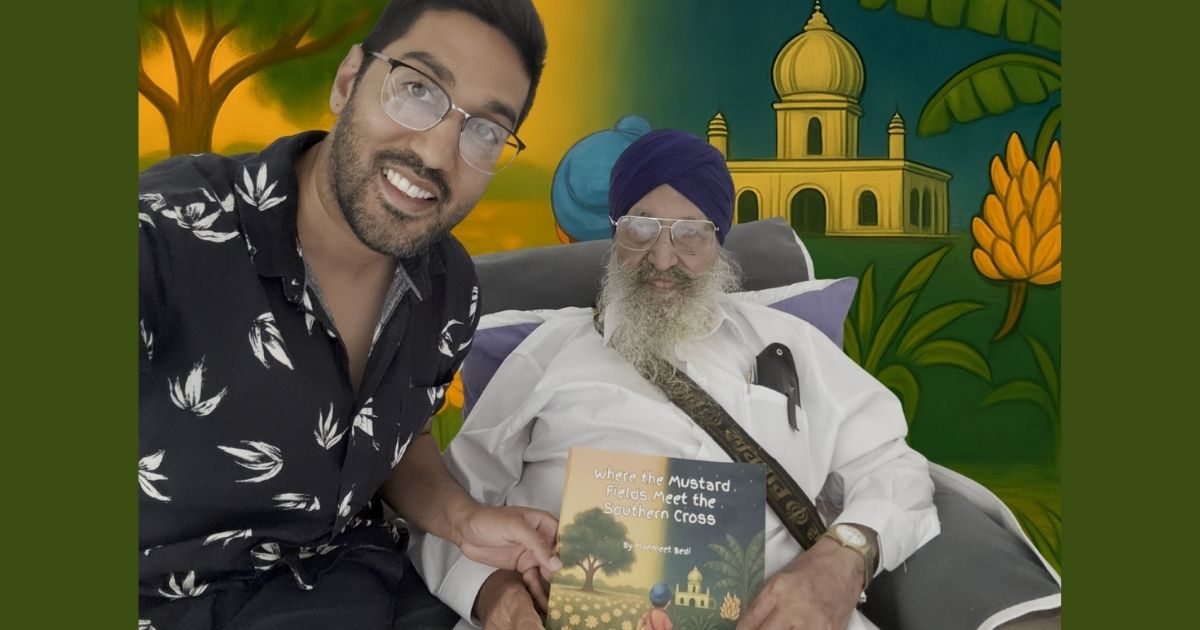
In 1885, my family crossed an ocean. Long before Australia became a federation, Sikh pioneers from Punjab arrived on these shores. They came not as temporary visitors, but as founders who would help shape the nation through labour, faith, and resilience. That realisation sparked the heart of this story and its central truth: founders, not guests.
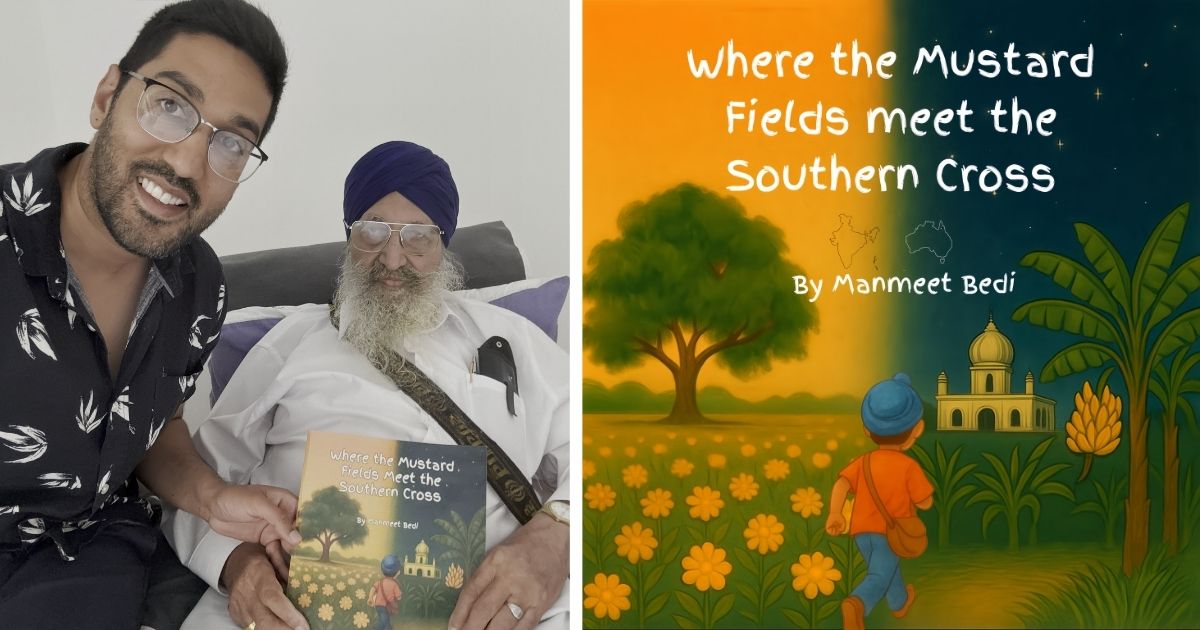
Where the Mustard Fields Meet the Southern Cross traces that journey across generations, from the earliest Sikh presence in Australia to a moment of community recognition in the modern day.
Once upon a time, in a green village in Punjab, a little boy named Teja Singh ran through fields of yellow mustard flowers. His grandmother often spoke softly as the wind moved through the crops.
“Your grandfather sailed to Australia in 1885,” she told him. “He worked hard and kept his turban high.”
Teja listened wide eyed, imagining a land beneath unfamiliar stars.
As he grew older, the world around him shifted. Borders were drawn and families uprooted. During the upheaval of Partition, Teja carried with him the courage passed down through generations.
In 1947, he stepped onto a ship in Bombay, bound for Australia. For more than a month, the sea rolled endlessly beneath him. Each night, he looked to the stars and whispered prayers to Guru Ramdas, asking for guidance across the waves.
The ship carried more than passengers. It carried hope.
When a fellow traveller fell ill, Teja shared his food and water without hesitation. One heart helping another, far from home.
Sydney greeted him with salty air and uncertainty. Life was not easy. His turban drew stares. Work was hard to find. Even water could be scarce.
Whenever doubt crept in, Teja remembered his grandmother’s words.
“Stand tall, my son.”
He travelled north to the cane fields of Gordonvale in Queensland, cutting sugarcane under the blazing sun alongside other Sikh pioneers. At night, they shared roti and songs that drifted into the warm Australian sky. These unseen moments formed the foundations of a growing community.
Years passed. Teja married and raised six children. At bedtime, he told them stories of Punjab’s rivers and Australia’s gum trees. Two worlds came together under one roof, forming a home grounded in faith, values, and belonging.
As machines replaced manual labour, Teja dreamed of land to call his own. He moved to Woolgoolga, where green hills met the sea, and established banana farms that sustained both family and region. The work was demanding, but hope grew with every seed planted.
Faith remained central to his life. Alongside others, he helped build some of the earliest gurdwaras in Australia, carrying bricks, painting walls, and singing as they worked.
“Where people pray together, love grows,” Teja would say.
He also helped establish Punjabi language classes and community festivals, ensuring the next generation understood who they were and where they came from. Neighbours from all backgrounds joined the celebrations, sharing food, music, and friendship.
One day, Teja Singh was called to the Woolgoolga town hall. In recognition of his service and contribution, he was named Citizen of the Year. It marked a powerful moment, not just for one man, but for a community that had journeyed from pioneer to recognised pillar of Australian life.
Today, Teja sits beneath the Southern Cross, reminding his grandchildren to be proud of who they are, to learn their language, to share their faith, and to help their neighbours.
His story is one of many. A reminder that our place here is not new, and our contribution is enduring.
No dream is too big when you remember where you come from and how far you can go.
By Manmeet Bedi
