


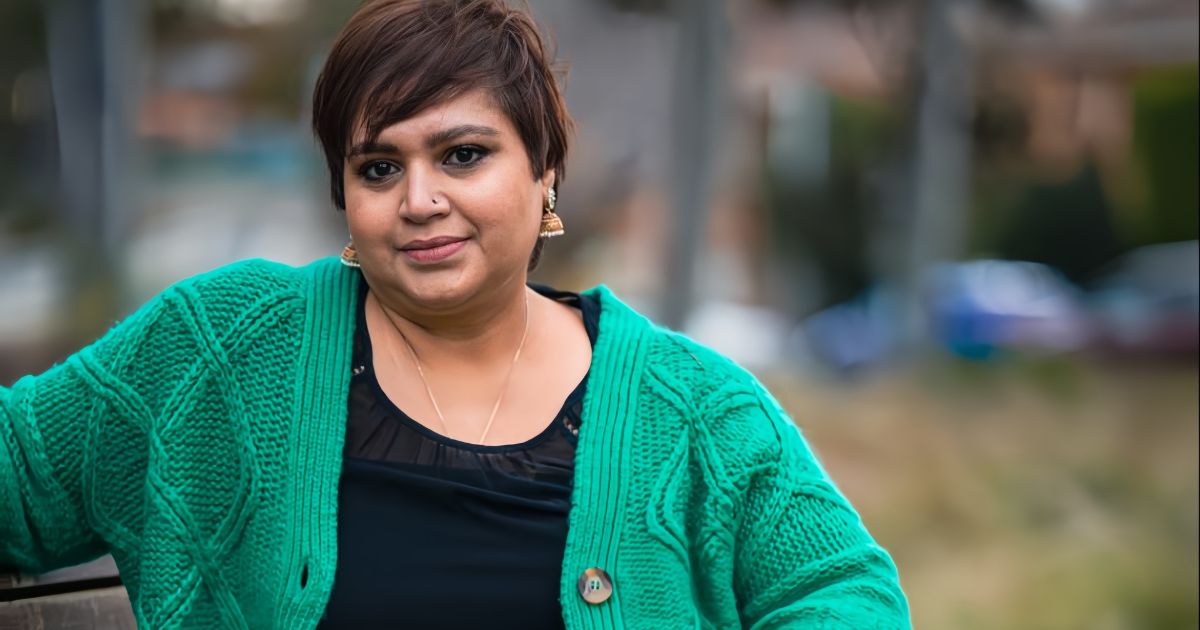
After a 40-metre fall, Nandita Chakraborty discovered her true calling in words and film.
When Nandita Chakraborty recalls her childhood, she remembers books. Born in Kolkata, raised between boarding schools and shifting cities, she often found herself tucked into a corner with a novel, making friends with characters on the page. But her path from booklover to author was anything but straightforward.
Her early years were marked by movement: from the pine forests of Meghalaya to the chaos of Delhi, where, at just twelve, she witnessed the 1984 riots. The violence and smoke in the air shattered the protective shell of her privileged upbringing, leaving an indelible impression of how fragile life could be.
In 1999, a business proposition brought Nandita to Melbourne. She opened a small boutique selling Indian jewellery and clothing, even supplying designer Alannah Hill. Back then, the Indian community was tiny spotting another Indian on the street was cause for excitement. But Melbourne became home, and over time, Nandita built a life that blended business, banking, and creativity.
Then came 2011. On 5 November, while rock climbing with friends, Nandita fell 40 metres. She survived, but the accident left her with an acquired brain injury. Therapy consumed the next nine months, yet denial lingered—she tried to push on as if nothing had changed. Only years later did she accept the invisible disability that would reshape her life.
And in that acceptance, she found writing.
In 2016, during speech therapy, Nandita picked up a pen and wrote a poem about her brain. That simple exercise became a spark. Soon she was writing stories, then novellas, then books. Today, she has three published works and is studying film and television, determined to bring her stories to the screen. She calls herself an “accidental writer,” but the discipline and passion that drive her are no accident.
Her inspiration, she says, is her mother. The two share a bond that is part care, part companionship. Her mother is her full-time carer, just as Nandita cares for her. “She understands me completely,” Nandita says. “I would not be who I am without her.”
Strength, she admits, comes from listening, from writing, and from trusting the stories she carries. Weakness is harder to confess: the struggle to step outside her comfort zone, to trust others again. Yet she is pushing herself every day.
What keeps her going? Dreams. “When I was at the bottom,” she reflects, “I always knew the only way was up.”
One quote guides her still, a line by Rumi: “The wound is where the light enters.” She first read it lying in a hospital bed, frightened and disoriented. The words—and a tiny beam of corridor light—felt like a promise that things would get better.
Her goals now are as ambitious as they are generous. She wants to amplify the voices of artists and people with invisible disabilities, to make them seen. She wants to keep writing and make films that matter. And she continues mentoring young writers, guiding students in India, and supporting those living with acquired brain injuries.
Success, to Nandita, is not measured in money or accolades but in giving. “If you give more,” she says, “it comes back to you tenfold.” Happiness, she adds with a laugh, is simply being with her mother and eating a hand-cooked puri.
Looking back, she wonders what life might have been if not for the fall—perhaps a banker, perhaps a mother. But she does not dwell there. “What I have now is enough,” she says. “More than enough.”
And so, Nandita Chakraborty continues, dreaming, writing, and reminding us that even wounds can be a doorway for light.
Tonee Sethi
