

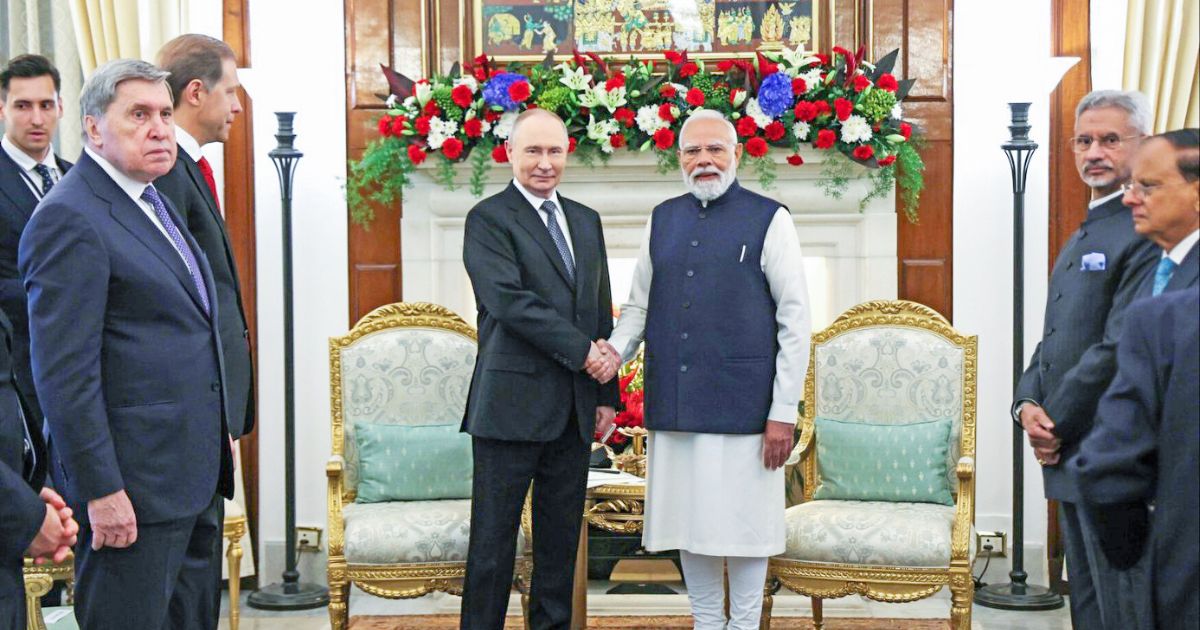
Delhi summit charts path toward broader trade, energy and defence cooperation — even as geopolitical pressures mount.
NEW DELHI, Dec 5: Russian President Vladimir Putin concluded a two-day state visit to India on December 5, 2025, marking a significant moment in the decades-long partnership between Moscow and New Delhi. The summit with Narendra Modi laid out ambitious plans to recast bilateral ties for a changing global landscape.
Trade and Economics: A $100 Billion Roadmap
At the heart of the visit was an agreement to deepen economic cooperation — not just in traditional sectors, but across shipping, fertilizers, energy, technology and labour mobility. The two sides unveiled a strategic economic cooperation programme aimed at boosting bilateral trade from roughly USD 69 billion (2024–25) to USD 100 billion by 2030.
Beyond oil, discussions spanned fertilisers, manufacturing, clean energy, critical minerals, pharmaceuticals and high-tech collaboration. Indian businesses were encouraged to “Make in India” under this renewed partnership.
Energy and Nuclear Cooperation: Commitments Amid Pressure
Perhaps the most politically charged outcome: Putin reaffirmed Russia’s commitment to supplying India with uninterrupted fuel — oil, gas, and coal — even in the face of pressure from the United States.
On the civil-nuclear front, both countries committed to advancing joint projects including the expansion of the existing Kudankulam Nuclear Power Plant and exploring future collaboration in small modular reactors and floating nuclear plants — part of India’s long-term clean energy and capacity goals.
Defence, Technology & Maritime Links: Diversification of Strategic Ties
While defence remains a foundational element, this visit signalled a shift: from largely weapons-centric deals to a broader focus on joint research, co-development, local manufacturing and high-tech collaboration. The two nations agreed to expand cooperation in areas such as space, AI, quantum computing, telecommunications, and defence manufacturing — marking a strategic pivot for the partnership.
On maritime cooperation, the leaders discussed strengthening shipping and logistics ties, including polar-water shipping training, revitalising corridors, and exploring a revamped marine-transport network that could ease connectivity between India, Russia and Europe — an important move in global logistics realignment.
People, Mobility, Soft Power: More Than Just High-Stakes Diplomacy
A flurry of MoUs signed during the visit underscore a drive to deepen people-to-people and cultural links: labour-mobility pacts, cooperation in health and food safety, academic and research collaborations, and tourism facilitation including easier e-visas for Russian nationals.
These steps suggest that the partnership is being reimagined as a comprehensive, multidimensional alliance — spanning energy, defence, trade, technology, education, labour and culture. As one editorial aptly summarised, “the economy is the new lynchpin” of the Indo-Russian relationship.
Diplomacy Amid Tensions: A Delicate Balancing Act
The visit comes at a time when Russia faces global isolation due to its ongoing war in Ukraine, and India is under growing pressure from the West, particularly the United States, over its energy ties with Moscow. Yet, both leaders used the summit to reaffirm their independent foreign-policy choices. Putin stressed that trade and cooperation would not be “affected by fleeting political swings,” underlining Russia’s commitment to India even amid sanctions.
For India, the deal underscores a continued commitment to strategic autonomy — protecting its energy security and long-standing partnerships, while gradually diversifying ties beyond defence and energy.
Why This Visit Matters — and What It Signals for the Future
This summit goes beyond pageantry or symbolic diplomacy. It marks a clear turning point: the traditional India–Russia bond — forged in defence and Cold War-era geopolitics — is being retooled for the 21st century. The new roadmap seeks to transform bilateral ties into a diversified, resilient, and future-ready alliance spanning energy, trade, technology, maritime connectivity, and human mobility.
As global geopolitics shifts and alliances are tested, the Modi–Putin meeting signals that New Delhi and Moscow aim to chart their own course — underscoring that strategic partnerships can evolve without losing their core foundation of trust and mutual interest.
(G’day India & Agencies)
